A neighbourhood to notice
Montmartre beyond the postcard
Montmartre asks you to look uphill, but its pleasures are often at eye level: a shop window, a bend in a narrow street, the change from a crowded square to a residential corner. Come for the famous outline of Sacré-Cœur, then decide which version of the neighbourhood you want to spend time in.
Open official visitor information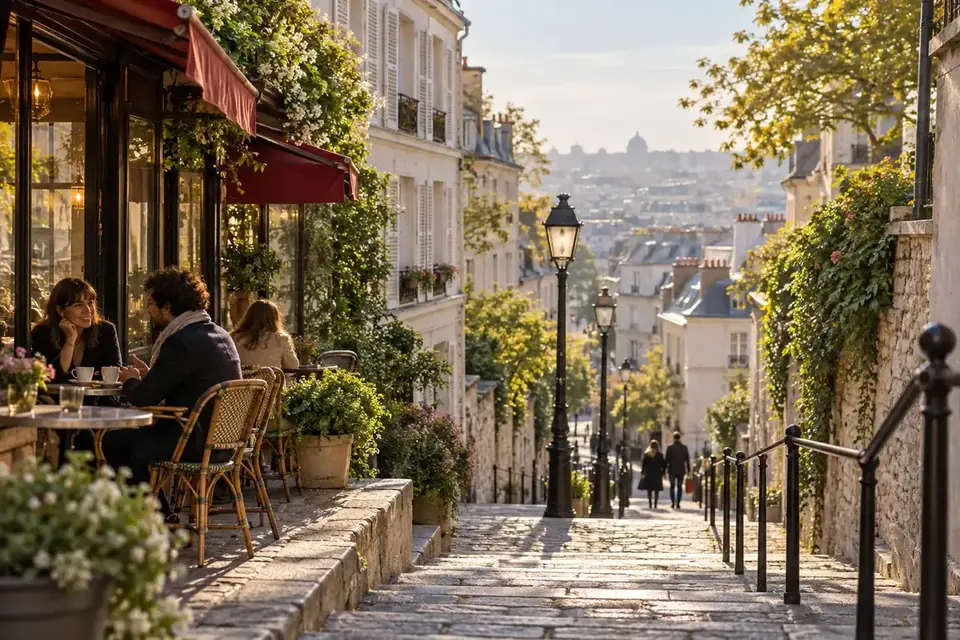
Meet a neighbourhood with several moods
Montmartre is most persuasive when you allow its contrasts to coexist. Around Sacré-Cœur and Place du Tertre, the experience can be intensely public: cameras, portrait artists and café tables. On adjoining slopes, doorways and everyday shops return the district to a smaller scale. Neither atmosphere cancels the other. Decide whether you want the theatre or the quieter details, then change your expectations as the streets change. Unlike the Eiffel Tower’s clearly framed silhouette, the hill is a place whose character emerges through fragments rather than one definitive view.
Use the panorama to understand the hill
Near the basilica, let the skyline become a pause rather than an identification contest. Notice the repetition of pale walls and dark roofs before searching for landmarks. The slope beneath your feet explains why this outlook feels different from a tower: you remain connected to streets and houses while looking over the city. If steps or steep ground are uncomfortable for someone in your group, that belongs in the choice of experience from the beginning. A beautiful viewpoint loses its pleasure when reaching it becomes an unspoken endurance test.
Separate the basilica from the photograph
Sacré-Cœur is an active place of worship as well as a recognisable outline. Enter because you are interested in the interior or a quieter moment, allowing the religious use to shape your behaviour. Follow the current visitor guidance and let people who have come to pray retain their space. Outside, the domes organise the scene; inside, your attention may shift to height, light and the pace of movement. You can value the building architecturally without turning worship into background scenery or assuming that every space functions as a sightseeing room.
Read Place du Tertre as a social scene
The square’s portrait artists offer a visible encounter with making images, but it is worth looking beyond the finished likeness. Watch how someone frames a face, exaggerates a feature or catches a pose, without intruding on a sitting. If you consider commissioning work, agree the format and terms directly first. The interest is different from a museum encounter: here an image is being negotiated between artist and subject in public. For the larger history of how Paris represents its inhabitants, Carnavalet’s objects and portraits of city life provide useful depth.
Give artistic history a real setting
The Bateau-Lavoir is associated with Picasso, Modigliani and Matisse, giving a famous artistic name a real geographical setting. The Musée de Montmartre adds interpretation, while its Renoir Gardens overlook the Clos Montmartre vineyard. Those cultivated spaces complicate the impression of a district made only of crowded steps and squares. Choose the museum if artistic history is your main interest, rather than collecting addresses without context. For paintings of modern leisure and performance across the wider city, Orsay’s nineteenth-century art provides a complementary view, with its own relationship to Montmartre’s creative identity.
Choose a pause that matches the street
A square-facing terrace makes the crowd part of your experience; a table away from the busiest corners may better suit conversation. Read the menu and decide whether you chiefly want a view, food or somewhere comfortable to sit. The same applies to a bakery window: a carefully chosen pastry with the texture you actually enjoy can make a more satisfying pause than a meal selected simply because a table is vacant. Let the neighbourhood’s appeal influence the occasion without assuming every attractive façade promises the same cooking or service.
Leave with a detail, not a legend
At the end, ask which small thing belongs to your version of Montmartre: a bend in a street, a drawing taking shape, or the sudden opening of a view. That detail keeps the visit from dissolving into a generic idea of bohemian Paris. If you want the evening to continue through music, choose a jazz programme for its musicians and listening format rather than expecting the hill’s artistic reputation to produce a performance. Cultural history becomes more rewarding when it leads to a considered present-day choice rather than an imagined scene.
Someone stopping for photographs will not move at the same pace as a keen walker. Choose one street or square to begin together, without making the climb everyone’s obligation. To turn these discoveries into a walking sequence, use the practical outline in a morning in Montmartre.
Prepare your visit
- Check official information for the basilica and any museum you select.
- Expect slopes and steps when judging your group’s comfort.
- Consult the guide separately for transport and accessibility planning.
Where will this discovery take you next?
Sources and updates
Confirm tickets, visit calendars and access conditions directly with the official source.
A publication affiliated with VIP Paris Transfer.
Editorial principlesHave you chosen where to go?
Explore metro, RER and travel options in our separate transport guide.
Open the transport guide