Colour beyond the canvas
Giverny: Monet’s garden as a living place
At Giverny, you enter a garden that continues to grow rather than a painting held still. Light, flowers and visitors keep changing the scene. If Monet’s work has made you curious about water, reflected colour and cultivated abundance, come ready to notice a living place whose appearance belongs to the season and the weather.
Open official visitor informationMeet a garden that will not stand still
Giverny is a living setting, not a three-dimensional copy of a Monet painting. Plants develop, light changes and people enter the view, so a photograph from another season cannot promise the scene you will meet. Choose the place because that variation interests you. Monet lived in the pink-rendered house from 1883 to 1926, allowing home, cultivation and painting to become closely related subjects. If you want the painted transformation rather than the living source, the Orangerie’s Water Lilies offer an entirely different way to concentrate on the artist’s vision.
Read the Clos Normand through its structure
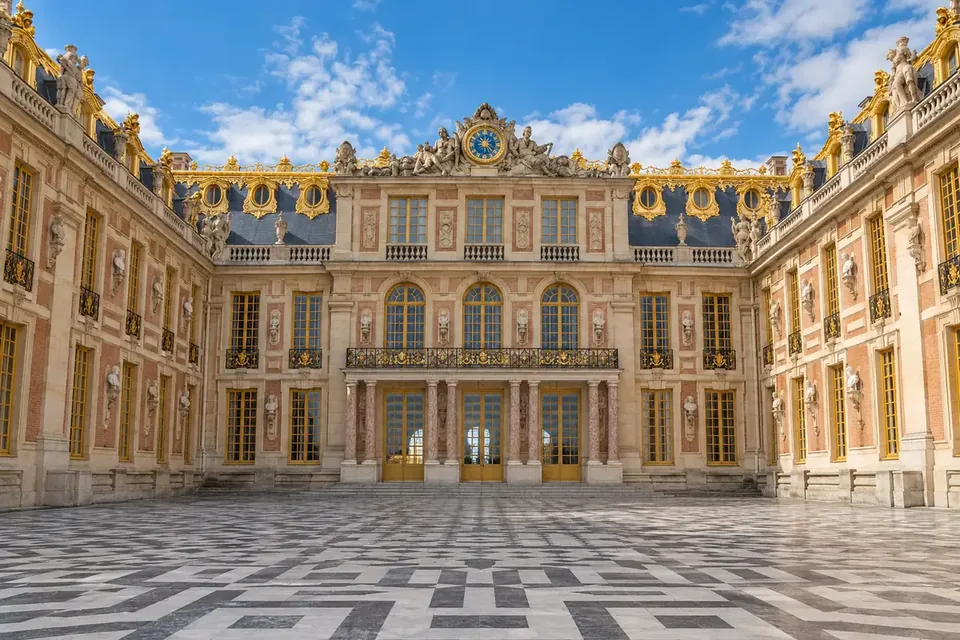
The Clos Normand is the flower garden, with paths passing beneath metal arches. Before trying to name every plant, notice the structure that holds the abundance: a line to follow, a repeated curve, a change in height. Then look at how colour interrupts or reinforces those lines. You can enjoy the gardening without expecting a particular bloom, since the appearance belongs to the season. If the formal perspectives at Versailles interest you, compare how these two cultivated places direct the eye. Giverny’s apparent profusion is not the absence of design, but a different experience of it.
Let the water garden move your attention
In the water garden, the Japanese bridge and lily pond connect directly with motifs associated with Monet’s paintings. Yet the experience is not simply finding the famous angle. Look at how a reflection complicates the edge between water and planting, or how a branch seems to continue below the surface. Stay within the permitted paths and give narrow viewpoints room to function for everyone. A shared garden can still reward close attention; you do not need an empty bridge or a perfect photograph for the relationship between light and water to become absorbing.
Understand what the house presents
The house adds domestic colour and scale, rather than a gallery of original Monet canvases. The studio/lounge contains reproductions arranged to evoke its historic appearance. That distinction lets you enjoy the room accurately: you are considering a working and living environment, not assessing an unexpected display of originals. For paintings in a museum context, Orsay’s collection and its approach to Impressionism provide another point of reference. At Giverny, look at how rooms relate to each other, what the windows frame and how the domestic setting changes your sense of the garden beyond it.
Notice yellow, blue and the objects between
The dining room pairs yellow walls and furniture with Monet’s collection of Japanese prints. The kitchen offers blue Rouen tiles and copper utensils, while the little blue lounge served as a reading room connected with a pantry. These are concrete reasons to give the house attention beyond a quick passage. Compare what the colours do to the feeling of each space. A room can appear vivid without being a painting, and an everyday utensil can carry visual interest. The pleasure lies in noticing deliberate surroundings at a scale different from the sweeping compositions you may associate with Monet.
Make space for several kinds of interest
A plant enthusiast, a painter and someone drawn to historic interiors may each find a different centre here. Agree on those interests before assuming everyone came for the same pond photograph. With children, a small search for reflected colours or repeated shapes can be enough; the principles of a curious family museum visit translate well when adapted to a garden and its rules. Avoid turning identification into a test. You can leave knowing few plant names while having paid real attention to how the setting is composed and how your own preferences guided the visit.
Choose Giverny for the right contrast
This is a seasonal, substantially outdoor experience, so current opening periods, weather and comfort matter to the decision. It is not interchangeable with a city museum simply because Monet connects them. The Rodin museum’s sculpture garden provides another artistic relationship with outdoor space, but bronze objects and growing motifs ask different things of your attention. At Giverny, the most interesting comparison may be between what you expected from pictures and what the living setting actually offered. Leave with one specific observation about colour, a room or a reflection, allowing the garden to remain more variable than the image that first drew you there.
Instead of searching for the exact colours in a photograph, notice the day’s light, leaves and reflections. One person may follow the painting connection while another studies the plants. Before putting this excursion on arrival day, consider the pace of the first evening after your flight.
Prepare your visit
- Confirm the official opening period, reservations and access information.
- Check weather and the practical implications of a mainly outdoor visit.
- Consult the transport guide or relevant transfer information separately.
Where will this discovery take you next?
Sources and updates
Confirm tickets, visit calendars and access conditions directly with the official source.
A publication affiliated with VIP Paris Transfer.
Editorial principlesHave you chosen where to go?
Explore metro, RER and travel options in our separate transport guide.
Open the transport guide